


NEWS
10 Sept 2026
"The Shape of Restraint" on ONE JAZZ Radio – "Donos Kulturalny"
"The Shape of Restraint" from "Roots" was featured in the September 2026 edition of "Donos Kulturalny", the monthly programme on the online station ONE JAZZ (onejazz.net), alongside new releases from ACT, GAD Records, For Tune and Dot Time. The episode premiered on September 10, 2026. Playlist and listening link on donos.home.blog.

7 Sept 2026
"Roots" on the JazzWeek Jazz Airplay Chart (USA)
"Roots" has been in rotation on US jazz radio since mid-June 2026 and is listed on the JazzWeek Jazz Airplay Chart — the weekly ranking of albums played by jazz stations across the United States. The record peaked in the week of August 10, 2026 and remains charted in September. Thank you to every station and host spinning the album!

1 Sept 2026
Jazz Forum Reviews "Perpetus" by Gniewomir Tomczyk
Jazz Forum (9/2026) reviews "Perpetus", the five-part suite by drummer Gniewomir Tomczyk inspired by the paintings of his father, Józef Tomczyk. Kuba plays double bass on the album alongside Mateusz Smoczyński, Krzysztof Lenczowski and Jan Smoczyński. Read the review by Piotr Iwicki (in Polish).

30 Aug 2026
"Roots" in Jazz Journal (UK)
Britain's Jazz Journal lists "Roots" among its new releases for August–September 2026: "a deeply personal solo album that reaches across generations, drawing on the living memory of a family uprooted by war, economic hardship, and the cruel luck of history — and finding in music a way home."

29 Aug 2026
Kuba Dworak on Polish Radio Trójka – "Mało Obiektywnie"
Kuba was a guest of Mariusz Owczarek on "Mało Obiektywnie" (Polskie Radio Program III), talking about "Roots" – the story behind the album, family memory and recording solo double bass. The episode, which also features pianist Adam Jarzmik, aired on the night of August 28/29, 2026. Listen to the full conversation on the Trójka website.

24 Aug 2026
Kuba Dworak in "Jazz i Grzech" on Radio JAZZKULTURA
Kuba was Grzegorz Telega's guest in "Jazz i Grzech" on Radio JAZZKULTURA (Kraków) – a two-hour conversation about his musical path, the story behind "Roots", and life between Poland and New York, with music chosen for the show. Broadcast on August 24, 2026 at 7 PM; the full episode is available to listen to online.

21 Aug 2026
"Roots" on Radio JAZZKULTURA (Kraków) – "Tour de Pologne"
Five tracks from "Roots" – "Angels – The Feeling of Death", "Ober No. 5", "A Man and the Willow", "The Shape of Restraint" and "Lullaby for Vistula River" – were played in "Tour de Pologne", Krzysztof Komorek's weekly show on Radio JAZZKULTURA devoted to the best new Polish jazz and improvised music. The episode (series 2, no. 29) premiered on August 21, 2026 at 9 PM, with a repeat later in the week.

17 Aug 2026
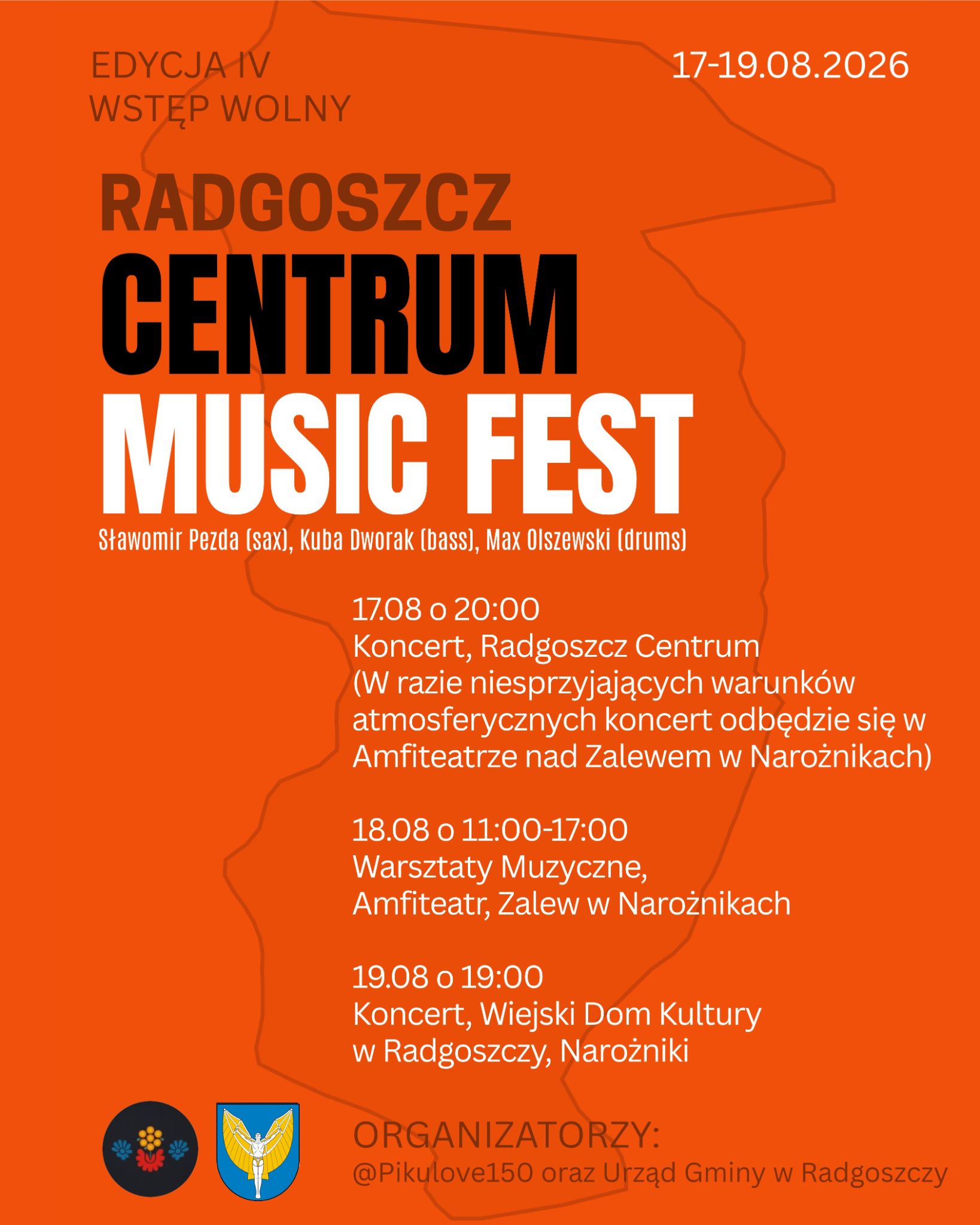
Radgoszcz Centrum Music Fest 2026 – 4th Edition
Three days of free music in Kuba's home village: the 4th Radgoszcz Centrum Music Fest (August 17–19, 2026) opens with a concert in the centre of Radgoszcz (Aug 17, 8 PM), continues with music workshops at the amphitheatre in Narożniki (Aug 18) and ends with a closing concert at the Narożniki Village Culture Centre (Aug 19, 7 PM). On stage: the trio Sławomir Pezda (saxophone), Kuba Dworak (bass) and Max Olszewski (drums). Organised by Pikulove150 and the Radgoszcz Municipality.
14 Aug 2026
Radio Kraków Kultura: Family History, Generational Trauma and Music for Solo Double Bass
Kuba talks to Mery Zimny on Radio Kraków Kultura ("Poranek z RKK") about "Roots" – recording alone in front of the microphone after years as a sideman, and how the album became a way to uncover his family's story of emigration, war and untold memories. "Telling all of this and recording the music brought me relief. It was an important process for me." Listen to the conversation (in Polish).

4 Aug 2026
"Roots" Reviewed by Donos Kulturalny
Polish culture blog Donos Kulturalny reviews "Roots" (Brooklyn Records Official). Robert Kasia calls the album a mature and consistent artistic statement — music that is focused, almost meditative, and demands attentive listening, with the double bass serving as melody, harmony and rhythm at once. The review singles out "Ober No. 5", "Kujawiak No. 7", "Mazur No. 6", "Knowing Too Much to Be at Peace", "Returning Without End" and "Lullaby for Vistula River". Read the full review (in Polish).

30 Jul 2026
Tinnitist: "Kuba Dworak Connects Us With His Roots"
Canadian music site Tinnitist features "Roots" — twelve unaccompanied double bass pieces that blend original compositions with traditional Polish forms such as the mazur and kujawiak. "Roots is an album about where we come from — a reflection on family, memory, place and identity," says Dworak. Darryl Sterdan also highlights the album's liner notes: a memoir by Kuba's great uncle recalling rural life in Poland during the Great Depression and World War II. Read the full feature.
26 Jun 2026
ROOTS OUT NOW!
Roots is a solo double bass album by Kuba Dworak that explores ancestry, memory, and the quiet architecture of identity.
Recorded between New York City and southern Poland, the album draws from the sonic landscape of rural Central and Eastern Europe. Fragments of folk and sacred melodies appear throughout the record — not as direct quotations to be preserved, but as living forms, reshaped through improvisation, repetition, and personal interpretation.
At its core, Roots is an attempt to reconnect with inherited memory. Dworak’s family history traces back to the village of Radgoszcz in southeastern Poland — a region shaped by migration, faith, and cultural layering. The album approaches this history not as something fixed, but as something that continues to evolve through sound.
The double bass becomes both instrument and medium. Low frequencies ground the music in a physical, almost architectural presence, while harmonics and resonances create a sense of space that feels suspended between past and present. Pizzicato passages echo dance rhythms that are at once familiar and transformed, carrying traces of tradition without settling into it.
Improvisation plays a central role throughout the record. Many pieces begin with simple structures — modal centers, drones, or melodic remnants — allowing the music to unfold organically. In this process, recognizable elements emerge and dissolve, as if memory itself were being reassembled in real time.
Rather than reconstructing tradition, Roots engages with it directly. Sacred and folk materials are not treated as distant references, but as active forces — questioned, reinterpreted, and brought into a contemporary context.
The album moves between intimacy and expansion, stillness and momentum. It does not aim to define identity, but to explore how it is shaped — through place, history, and sound.
Roots is both a return and a transformation.
